LaserVerse develops custom laser harps as performance instruments, public installations and gateways into larger interactive experiences.
Breaking a beam can play a note, but that is only the beginning! A LaserVerse system can change colour, reshape projected worlds, trigger composed musical passages, animate light, control external devices or transform an entire audiovisual environment in real time.
What is a laser harp?
A laser harp replaces physical strings with beams of light.
When a performer or participant interrupts a beam, sensors and control systems detect that interaction and translate it into an electronic event. Traditionally, that event has been used to trigger a synthesiser note or MIDI message. Contemporary systems can send control information to computers, samplers, lighting systems and other interactive technologies.
The result is an unusual instrument: something simultaneously musical, sculptural and theatrical.
There is nothing to pluck.
Nothing to strike.
The performer reaches directly into light.
A brief history of the laser harp
The origins of the laser harp sit at the intersection of experimental music, electronics and performance technology.
French composer and visual artist Bernard Szajner developed an early operational laser harp around 1980 and filed a French patent in 1981 for a laser-controlled musical synthesiser system. Australian laser artist Geoffrey Rose has separately claimed an earlier laser-harp design dating from the mid-1970s, so the instrument’s earliest history is not entirely uncontested.
The instrument became internationally recognised through Jean-Michel Jarre, who incorporated a laser harp into his landmark 1981 concerts in China. It subsequently became one of the visual signatures of his live performances and has remained associated with his work for decades.
Later artists expanded the idea beyond the concert stage. Interactive laser-harp installations have increasingly explored public participation, movement, sound and collective play.
The essential idea remains extraordinarily powerful:
Human movement + light = control.
What can happen after that interaction, however, has changed enormously.
Beyond playing notes
Many laser harps operate fundamentally as musical controllers: interrupt a beam and trigger a note or programmed message.
LaserVerse approaches the laser harp differently.
We treat each beam as a programmable interactive input.
That means a single gesture can become part of a much larger creative system.
· Perform an individual sound or an evolving musical phrase
· Trigger layered compositions, rhythms or sequences
· Change beam colour in real time
· Trigger colour presets and responsive states
· Animate or visually vibrate laser beams
· Respond to music and audio
· Manipulate projection-mapped visuals
· Transform generative or 3D environments
· Trigger lighting, lasers and performance effects
· Send commands to external control systems
· Trigger relays, motors, mechanisms or physical devices
· Become part of an entirely custom interaction designed around a venue, artwork or story
At its simplest, a beam plays a sound.
At its most ambitious, the performer plays the installation itself.
Music rather than sound effects
A major focus of the LaserVerse approach is musicality.
Interactive installations can easily become collections of disconnected sound effects: touch something and hear a noise.
A laser harp can go much further.
Individual beams can form part of a composed musical system — triggering harmonies, phrases, rhythmic structures, evolving arrangements or layers that remain musically coherent regardless of who is playing.
A first-time participant does not need to be a trained musician to create something rewarding.
For a skilled performer, the same system can become expressive enough to genuinely perform.
This allows a LaserVerse laser harp to occupy the space between instrument, artwork and experience.
Light that responds
The visual behaviour of the instrument can be just as expressive as its sound.
LaserVerse systems can incorporate programmable beam colour, colour presets, responsive states, audio-reactive behaviour and animated beam movement.
A beam does not necessarily need to remain a static line waiting to be interrupted.
It can change colour when played.
It can pulse with music.
It can visually vibrate.
It can move.
It can become part of a larger laser composition surrounding the participant.
The interaction therefore becomes visible to everyone watching — not only audible to the person playing it.
From instrument to immersive installation
A laser harp can stand alone on a stage.
But some of the most interesting possibilities emerge when it becomes the control surface for something larger.
Projection mapping can transform architecture or sculptural surfaces as individual beams are played. Generative-media systems can continuously reinterpret participant actions. Sound can move beyond individual samples into evolving composition. External control systems can connect an interaction to lighting, kinetic devices, mechanisms or other physical responses.
In principle, the interruption of a beam is simply information.
What that information controls is a creative decision.
THE LIGHT IS THE INTERFACE.
LaserVerse laser-harp works

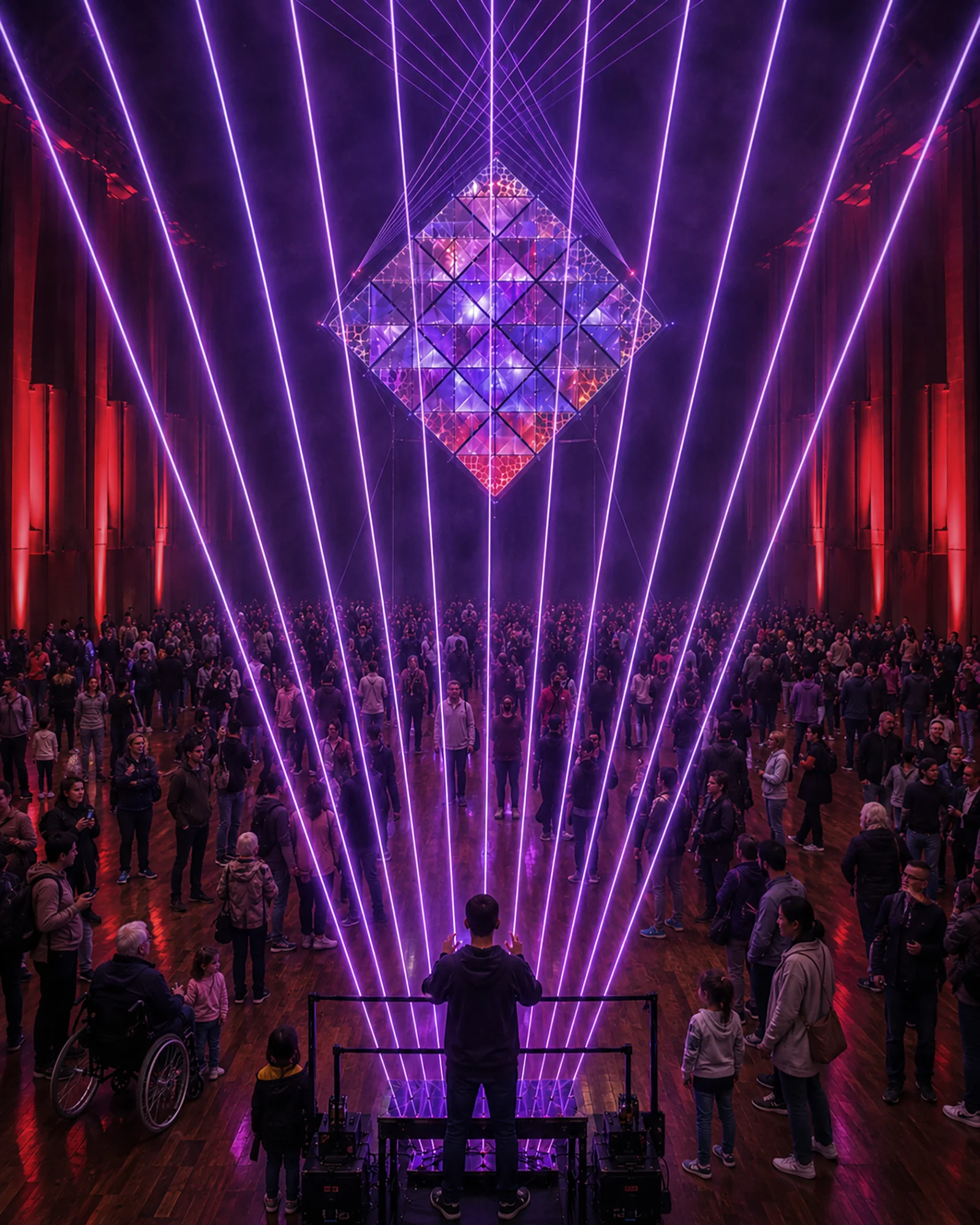
The Performer
Giant Interactive Laser Harp
A monumental twelve-beam instrument developed for large-scale public participation.
A monumental twelve-beam instrument developed for large-scale public participation. Participants reach into vertical laser strings to perform music while the surrounding audiovisual installation responds around them. Presented at White Night Ballarat 2024, The Performer demonstrates how the laser harp can move beyond individual performance and become a shared public experience.
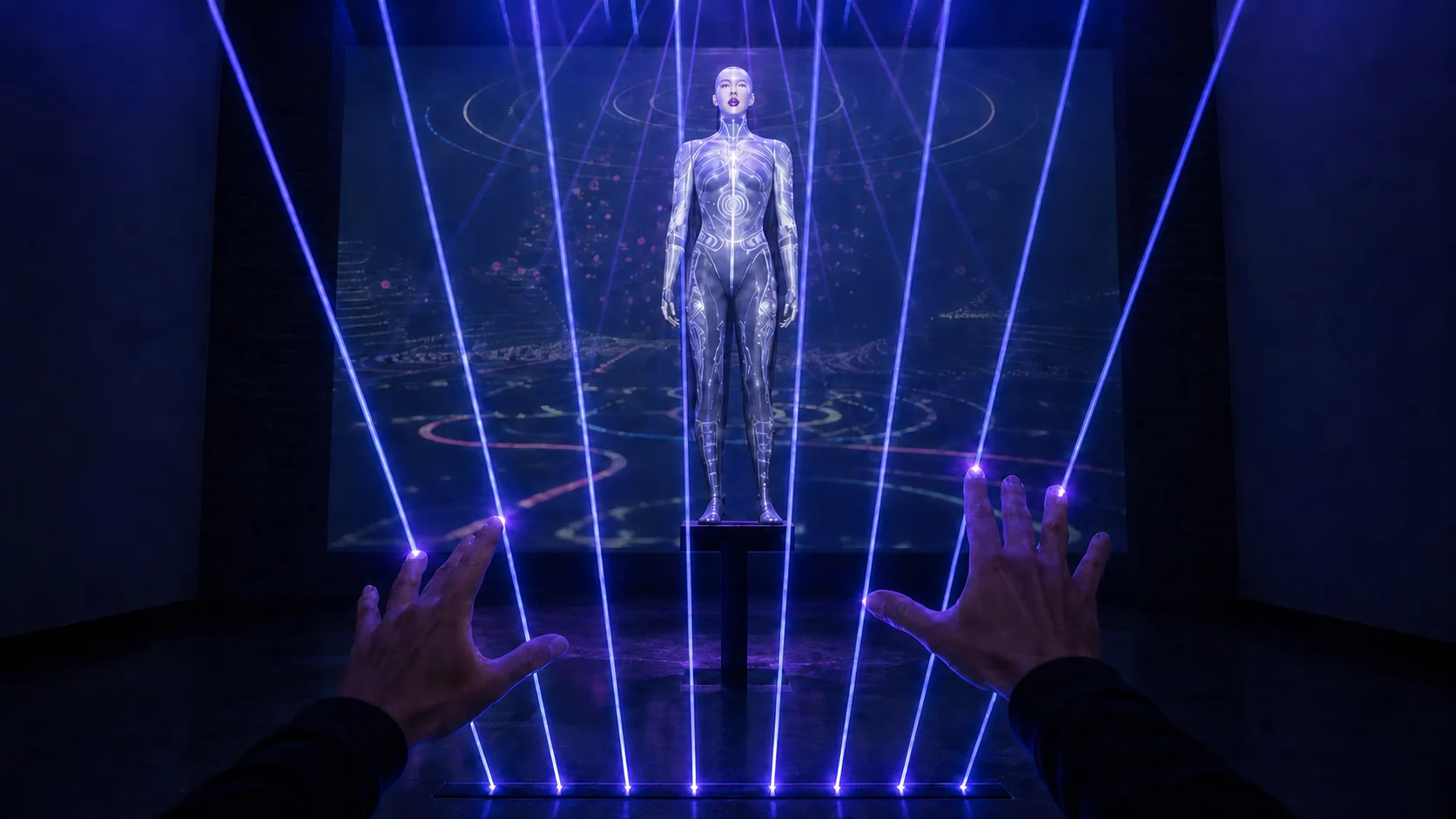
Interhuman Crescendo
Interactive Laser Installation
Laser-harp interaction combining light, sound, projection and participant behaviour.
Developed for Melbourne’s Museum of Desire, Interhuman Crescendo transformed laser-harp interaction into a responsive installation combining light, sound, projection and participant behaviour. The installation operated for approximately eighteen months and engaged more than 55,000 museum visitors.
Custom laser harps and commissions
No two installations need to behave the same way.
LaserVerse can develop laser-harp systems around an existing work, a venue, an architectural environment, a performance concept or an entirely new commission.
The system might become a musical instrument. It might become public art. It might control projection across architecture. It might animate a sculpture. It might trigger physical machinery. Or it might become something that has never previously been called a laser harp at all.
Have an idea involving interactive light?